This guide shows you, step by step, how to set up a desktop AI assistant (Grok Bot) and an exchange account so you can follow Stark Signals in a structured, disciplined way — with several AI agents that each have one clear job, and you giving the final “YES” before any order is placed.
1 Overview: how the flow works
Every signal from the Stark Signals Telegram channel passes through the same chain. No agent can skip a step, and nothing reaches the exchange without your explicit approval.
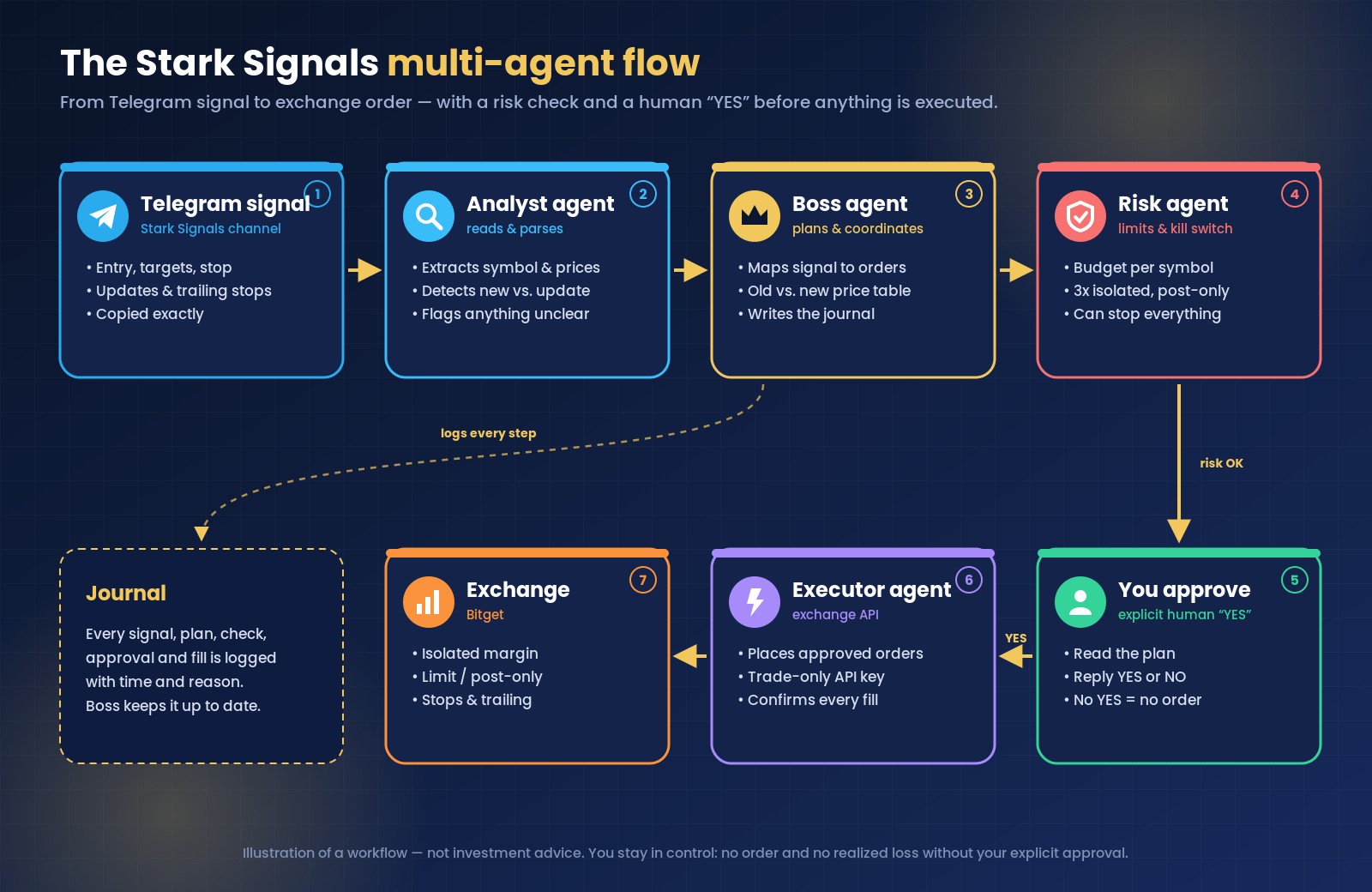
- Telegram signal — a new signal or an update (entries, targets, stop, trailing stop) is posted in the channel.
- Analyst agent — reads the message, extracts symbol, direction and prices, and flags anything unclear.
- Boss agent — plans the trade, maps the signal to concrete orders (old vs. new prices for updates) and writes everything into the journal.
- Risk agent — checks the plan against your limits (budget per symbol, leverage, margin mode, order type) and can trigger a kill switch.
- You — review the plan and reply YES (or NO). No YES, no order.
- Executor agent — places exactly the approved orders via the exchange API and confirms the result.
- Exchange — orders are placed on your own account. You stay the owner of your account and your funds at all times.
2 Install the AI assistant and create your agents
- Install Grok Bot — download the Grok Bot desktop AI assistant app from its official website, install it on your computer and sign in. Only use the official download source.
- Get familiar with the app — the app’s own help and settings explain how to create agents (sometimes also called assistants or workspaces) and how to give each one instructions. Menu names can change between versions, so follow the in-app guidance.
- Create four agents — Boss, Analyst, Risk and Executor. Give each agent the role description below (copy and adapt it to your own limits).
- Give the Executor the exchange connection only — the API key is connected through the assistant’s connector or secure secret field (see section 3), never typed into a chat.
- Test in a dry run — let the agents process a few signals without placing orders until you are comfortable with how they work.
👑 Boss agent
Plans, coordinates and keeps the journal.
You are the Boss agent. You receive parsed signals from the Analyst. Map each signal to concrete orders following our rules (isolated margin, 3x, post-only limit orders, exact signal prices, fixed budget per symbol, staged entries). For updates, show an Old | New table. Send every plan to the Risk agent, then ask the human for an explicit YES. Never let anything be executed without that YES. Log every step in the journal.
🔎 Analyst agent
Reads and structures the signals.
You are the Analyst agent. Read each new Stark Signals message. Extract symbol, direction, entry prices, targets, stop loss and trailing-stop changes exactly as written. Say whether it is a new signal or an update to an existing one. Never guess: if anything is ambiguous, flag it and ask. You do not place orders.
🛡️ Risk agent
Enforces limits, owns the kill switch.
You are the Risk agent. Check every plan before it goes to the human: budget per symbol (about 400 USD initial margin), isolated margin, 3x leverage, post-only limit orders, prices identical to the signal. Block any plan that would realize a loss without explicit human approval. If something looks wrong, stop the process (kill switch) and explain why.
⚡ Executor agent
The only agent with exchange access.
You are the Executor agent. You only act on plans that the Risk agent passed AND the human approved with an explicit YES. Place exactly those orders via the exchange connection, nothing more. Report back order IDs, prices, sizes and status. Never withdraw, never transfer funds, never change limits.
These role descriptions are examples. Adapt them to your own budget and risk tolerance.
3 Exchange account and API key (Bitget or Phemex)
We use Bitget for our own setup; Phemex works the same way. You can open an account via our referral links:
Bitget
Crypto exchange with USDT-margined futures, isolated margin and API trading.
Phemex
Crypto exchange with USDT-margined futures, isolated margin and API trading.
Affiliate disclosure: these are referral links. If you sign up through one of them, we may earn a commission. This does not cost you anything extra and does not influence our signals.
Set-up steps
- Create your account using one of the buttons above, with a strong, unique password.
- Complete identity verification (KYC) as requested by the exchange.
- Enable two-factor authentication (2FA) with an authenticator app — not just SMS.
- Fund your futures account only with money you can afford to lose completely.
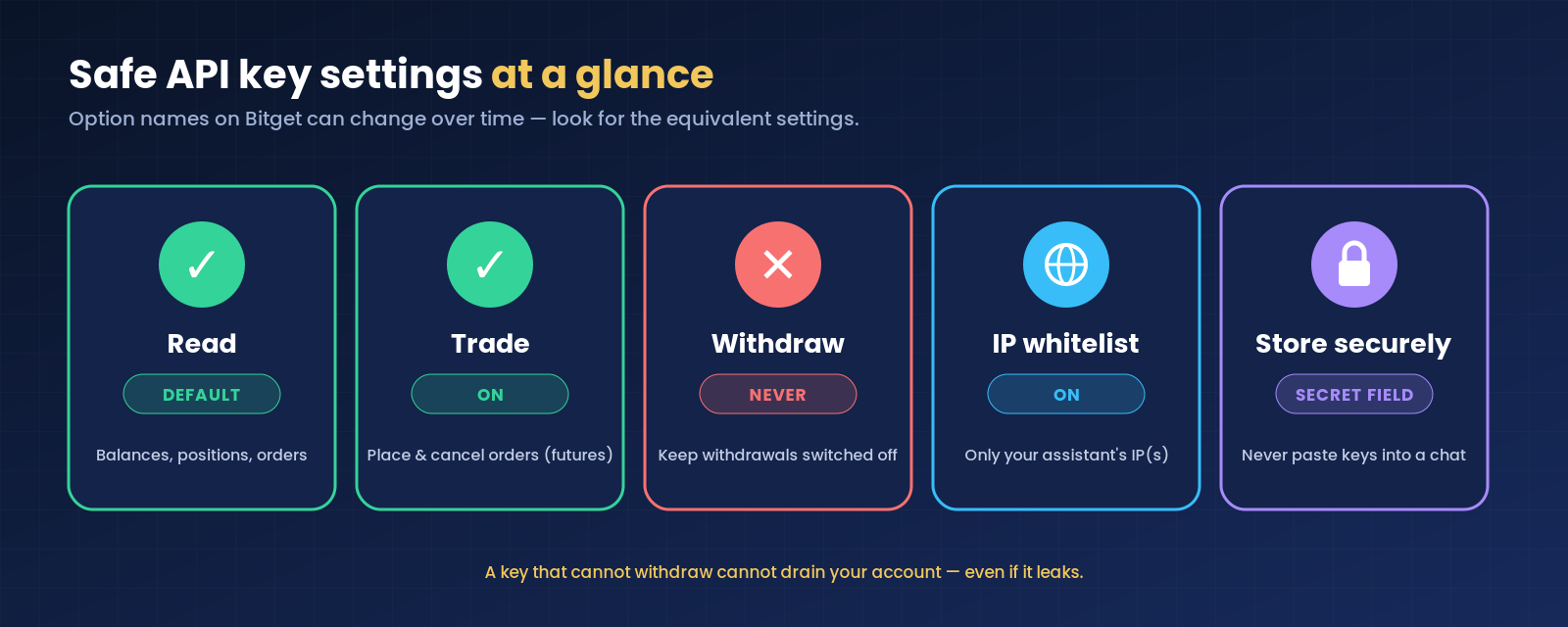
- Create an API key in your account’s API management:
- Permission: trade only (read access is usually included by default).
- NEVER enable withdrawal or transfer permissions.
- IP whitelist: restrict the key to the IP address(es) your assistant uses.
- Write down the passphrase safely — the secret is usually shown only once.
- Connect the key securely — enter it only in the assistant’s connector or secure secret/credentials field. Never paste API keys or secrets into a chat message, an email or a screenshot.
4 Our trading rules
These are the rules our own agents follow. The Risk agent checks every plan against them.
Isolated margin
Each position has its own margin. One trade can never eat the whole account.
3x leverage
Fixed, moderate leverage. No exceptions, no “just this once”.
Post-only limit orders
Orders rest in the order book at your price — no market orders, no surprise fills.
Copy prices exactly
Entries, targets and stops are taken 1:1 from the signal. No rounding, no “improving”.
Fixed budget per symbol
About 400 USD initial margin per symbol. Same size every time.
Staged entry fans
The budget is split across several entry levels instead of one all-in order.
Trailing stops 1:1
When the signal moves the stop, we move it the same way — immediately and exactly.
No realized loss without you
No agent may close a position at a loss unless you have explicitly approved it.
Every order needs your YES
Each order is placed only after an explicit human “YES”. Silence is a NO.
Journal everything
Every signal, plan, check, approval and fill is logged with time and reason.
5 Example agent conversations
The mock-ups below show how a typical signal update flows through the agents. All symbols, prices and sizes are fictional example data — not a real trade and not a recommendation.
📊 ABCUSDT long – signal update (EXAMPLE DATA)
Symbol           | Old      | New
✅ ABCUSDT E1    | 1.2400   | 1.2400  (unchanged)
✅ ABCUSDT E2    | 1.2200   | 1.2150
✅ ABCUSDT E3    | 1.1950   | 1.1900
✅ ABCUSDT SL    | 1.1600   | 1.1500
Budget: 400 USD margin · 3x · isolated · post-only
Plan: cancel and re-place E2 and E3 at the new prices, move SL. Sent to Risk. Logged in journal.
📊 XYZUSDT – trailing stop (EXAMPLE DATA)
Symbol           | Old      | New
✅ XYZUSDT TS    | 2.4300   | 2.4800
Copied 1:1 from the signal. Sent to Risk.
Example data only. Symbols ABCUSDT and XYZUSDT are placeholders, prices are invented.
6 Security checklist
- 2FA (authenticator app) is enabled on your exchange account and email.
- API key has trade permission only — withdrawals are disabled.
- API key is restricted to whitelisted IP addresses.
- API keys are stored only in the assistant’s connector / secure secret field — never in chats, emails or screenshots.
- Only the Executor agent has access to the exchange connection.
- Every order requires your explicit “YES”; no realized loss without your approval.
- Budget per symbol, leverage and margin mode are fixed and checked by the Risk agent.
- You know how to stop everything quickly (kill switch) and how to revoke the API key.
- You review the journal regularly and rotate API keys from time to time.
- You trade only with money you can afford to lose completely.
⚠️ Important risk disclaimer
- No investment advice. Stark Signals and this guide are for information and education only. They are not investment, financial, legal or tax advice and not a recommendation to buy or sell anything.
- High risk of loss. Trading crypto assets and leveraged derivatives (futures) is highly speculative. You can lose your entire capital. Leverage amplifies losses as well as gains, and positions can be liquidated.
- No guarantee. Past performance is not an indicator of future results. Signals can be wrong, late or not executable at the stated price.
- AI and technology risks. AI assistants can misunderstand messages or make mistakes. Software, connections, APIs and exchanges can fail. You remain responsible for checking and approving every action.
- Your account, your decision. Hegglin Trading GmbH does not manage your money, has no access to your exchange account and does not place trades for you. All decisions and orders are yours.
- Third-party services. Exchanges and AI tools are third-party services with their own terms, fees and risks. Availability depends on your country of residence — check the terms that apply to you.
Only trade with money you can afford to lose completely. If in doubt, seek advice from an independent, licensed professional.
Stark Signals · Hegglin Trading GmbH, Zug, Switzerland · Subscription: CHF 50 / month or CHF 500 / year.